English
Disposable Food Containers With Lids: QC Points to Include in an RFQ
Created on 03.16
Finding the right supplies for your restaurant can be tough. The packaging of a meal is a big part of the experience. We aim to help you find vendors who focus on safety and durability.
Writing a clear RFQ sets the right expectations from the start. By adding strict quality control standards, we make sure every shipment is up to par. This saves us time and avoids expensive errors later.
disposable food containers with lids
Our disposable food containers with lids must be strong for hot deliveries. Using precise specifications helps protect your brand and keeps customers coming back. Let's look at the technical details that matter in your sourcing documents.
Key Takeaways
- Specify exact material thickness to ensure product sturdiness.
- Require rigorous leak-proof testing for all lid designs.
- Define temperature resistance ranges for hot and cold storage.
- Request proof of food-grade certifications from every supplier.
- Set clear tolerances for how tightly the lids must fit.
- Outline bulk shipping standards to prevent damage during transit.
Why Quality Control Matters When Sourcing Disposable Food Containers With Lids
Quality control is very important for disposable food containers with lids. It affects food safety and how much customers trust us.
Buying these containers is more than just a purchase. It's about keeping our customers safe and happy. Good quality checks help find problems like bad materials or not following rules.
"The safety of food packaging is a critical concern for consumers and manufacturers alike. Ensuring that packaging materials are safe and compliant with regulations is essential for protecting public health."
Let's look at why quality is so key:
- Material specifications and compliance with food safety regulations
- Structural integrity and performance of the containers
- Lid fit and seal quality to prevent leakage
- Dimensional tolerances and capacity verification
Quality Aspect | Importance | Consequence of Failure |
Material Specifications | Ensures compliance with food safety regulations | Risk of contamination and regulatory non-compliance |
Structural Integrity | Prevents leakage and maintains container shape | Leakage and damage to contents |
Lid Fit and Seal Quality | Prevents spillage and maintains freshness | Spillage and loss of freshness |
By focusing on quality, we make sure our customers are happy. This keeps their trust, which is crucial for our business. Our dedication to quality control means we deliver top-notch products.
Material Specifications and Compliance Requirements
Checking the quality of disposable food containers with lids means looking at their materials and following rules. We need to make sure these containers are safe, green, and work well.
Food-Grade Material Standards
Food-grade materials are all about keeping consumers safe. The materials in these containers must meet strict standards. This is to stop contamination and make sure they don't mix harmful chemicals with food.
FDA Approved Materials
In the U.S., the Food and Drug Administration (FDA) sets the standard for food-grade materials. FDA-approved materials are safe for food contact. Manufacturers must follow FDA rules for their products.
BPA-Free and Phthalate-Free Requirements
Today, many want containers without harmful chemicals like BPA and phthalates. We make sure our containers are BPA-free and phthalate-free. This keeps consumers safe.
Chemical Composition Testing
Testing the chemical makeup of materials is crucial. It checks if the materials have harmful substances that could harm health.
Heavy Metal Content Limits
Rules set limits on heavy metals like lead, cadmium, and mercury in food contact materials. We stick to these limits to keep our products safe for everyone.
Additive Disclosure
Manufacturers must tell us what additives they use. Knowing this helps us see if they follow safety standards.
"The safety of food contact materials is paramount. Ensuring compliance with regulations and standards is not just a legal requirement but a moral obligation towards consumers."
Environmental and Sustainability Certifications
Environmental concerns are also important. Certifications like compostability or recyclability help reduce the environmental impact of these containers.
Certification | Description | Benefits |
Compostable | Materials that can decompose into nutrient-rich compost. | Reduces landfill waste, creates valuable compost. |
Recyclable | Materials that can be processed and reused. | Conserves resources, reduces waste. |
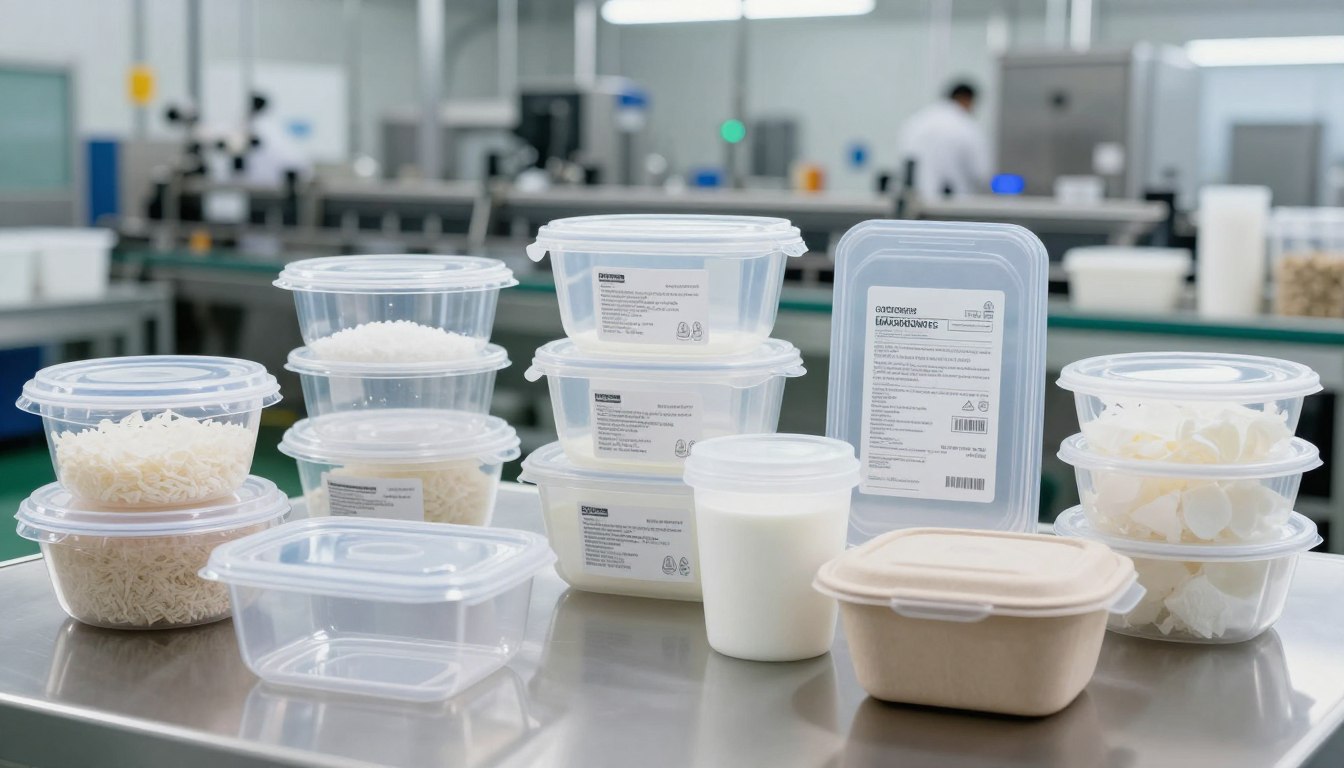
A visually striking arrangement of various food-grade packaging materials, prominently showcasing disposable food containers with lids in a clean, well-lit factory setting. In the foreground, a variety of transparent and opaque containers in different shapes and sizes, made from BPA-free plastics and compostable materials. The middle ground features detailed close-ups of compliance labels and material specification sheets, emphasizing safety certifications. In the background, a sterile production line with a soft-focus to highlight quality control processes, illuminated by bright, even lighting to create a professional industrial atmosphere. The mood is informative and precise, tailored for a business audience focused on material specifications and compliance in packaging.
By focusing on material specs and following rules, we make sure our containers are safe and good for the planet.
Structural Integrity and Performance Testing
Disposable food containers with lids must go through tough tests. These tests check if the containers can handle different conditions safely. This ensures the food stays safe and good to eat.
Container Strength and Durability
The strength and durability of these containers are key. They must protect food well during handling, storage, and transport. We test them to make sure they meet the needed standards.
Drop Test Requirements
Drop testing checks if containers can handle impacts. They must not leak or get damaged badly when dropped from a certain height. This test makes sure the containers stay strong and protect food even when dropped by accident.
Compression Resistance
Compression resistance testing checks how well containers stack and handle pressure. They should not bend or break under pressure. This ensures they stay useful and keep their shape.
Temperature Resistance Parameters
Disposable food containers face many temperatures, from cold to hot. It's important to test their temperature resistance. This makes sure they work well in different temperatures.
Hot Food Temperature Tolerance
Containers for hot foods need to handle high temperatures. They must not bend or leak when exposed to high heat. This test checks if they can handle these temperatures safely.
Cold Storage and Freezer Capability
Containers for cold or frozen use must stay strong and not leak. They should not get brittle or break in cold temperatures.
Microwave Safety Standards
Many containers are used in microwaves for reheating. It's important they are safe for microwaves. This test checks if they can handle microwave heat without problems.
Leak and Spill Prevention Testing
Preventing leaks and spills is a main job of these containers. We test if they can keep liquids or semi-solids inside. This is key for keeping things clean and avoiding messes.
Lid Fit and Seal Quality Control Points
The lid fit and seal quality are key for keeping food fresh and preventing spills. We focus on the important steps to ensure our containers are top-notch. This includes checking the lid fit and seal to meet high standards of performance and safety.
Lid Attachment Mechanisms
How a lid attaches to a container is crucial for its use and effectiveness. We look at two main ways: snap-on closures and hinged lids.
Snap-On Closure Strength
A snap-on closure needs to stay shut during use and transport. Testing the snap-on closure strength checks if it can open and close many times without failing.
Hinged Lid Durability
Hinged lids must be durable. The hinge should handle lots of opening and closing without breaking or wearing out. We test the hinged lid durability by simulating different use cases.
Seal Integrity Testing
It's essential to check if disposable food containers seal well. This prevents spills and keeps food fresh.
Air-Tight and Liquid-Tight Performance
Containers should keep air and liquids out. We test our containers to make sure they pass these tests under different conditions.
Tamper-Evident Features
Tamper-evident features add security. They show if a container has been opened or tampered with. Adding these features makes our products more trustworthy.
Compatibility and Interchangeability
Lids and containers should work well together for easy use. We make sure our lids fit perfectly with their containers. This makes using them convenient and reduces spill risks.
Dimensional Tolerances and Capacity Verification
When looking for disposable food containers with lids, it's key to check their size and how much they can hold. These details affect how well the containers work, how they're stored, and if customers are happy.
Size and Volume Specifications
To make sure containers meet the standards, we need to check their size and how much they can hold. This means looking at both how much they can hold inside and their outside measurements.
Internal Capacity Measurements
How much a container can hold inside is very important. Getting the internal capacity right is key for happy customers and following rules.
For example, a 500ml container should really hold 500ml without spilling or leaking.
External Dimension Standards
The outside measurements of containers are also crucial. Standard outside dimensions help them stack and nest well, saving space.
Here's a table showing standard outside dimensions for different sizes:
Container Size | External Length (mm) | External Width (mm) | External Height (mm) |
Small | 120 | 80 | 50 |
Medium | 150 | 100 | 70 |
Large | 200 | 150 | 100 |
Stackability and Nesting Requirements
Containers need to stack and nest well for easy storage and transport. This saves space and cuts costs.
Stacking Height Limits
Setting limits on how high containers can be stacked is important. It prevents them from becoming unstable and getting damaged.
"The key to efficient storage is not just the size of the containers, but how they are designed to interact with each other."
— Industry Expert
Nesting Ratio for Storage Efficiency
The nesting ratio shows how well containers fit together when not in use. A higher ratio means better storage.
For example, a nesting ratio of 3:1 means three containers fit in the space of one.
Acceptable Tolerance Ranges
It's important to set limits for how much containers can vary in size. This ensures they fit together right and work as they should.
Tolerance ranges should be set for both how much they can hold inside and their outside size. This allows for small differences in making while keeping quality high.
Safety and Hygiene Quality Standards
Disposable food containers with lids must meet strict safety and hygiene standards. This is to prevent microbiological hazards and chemical contamination. It's vital for public health and trust in the food industry.
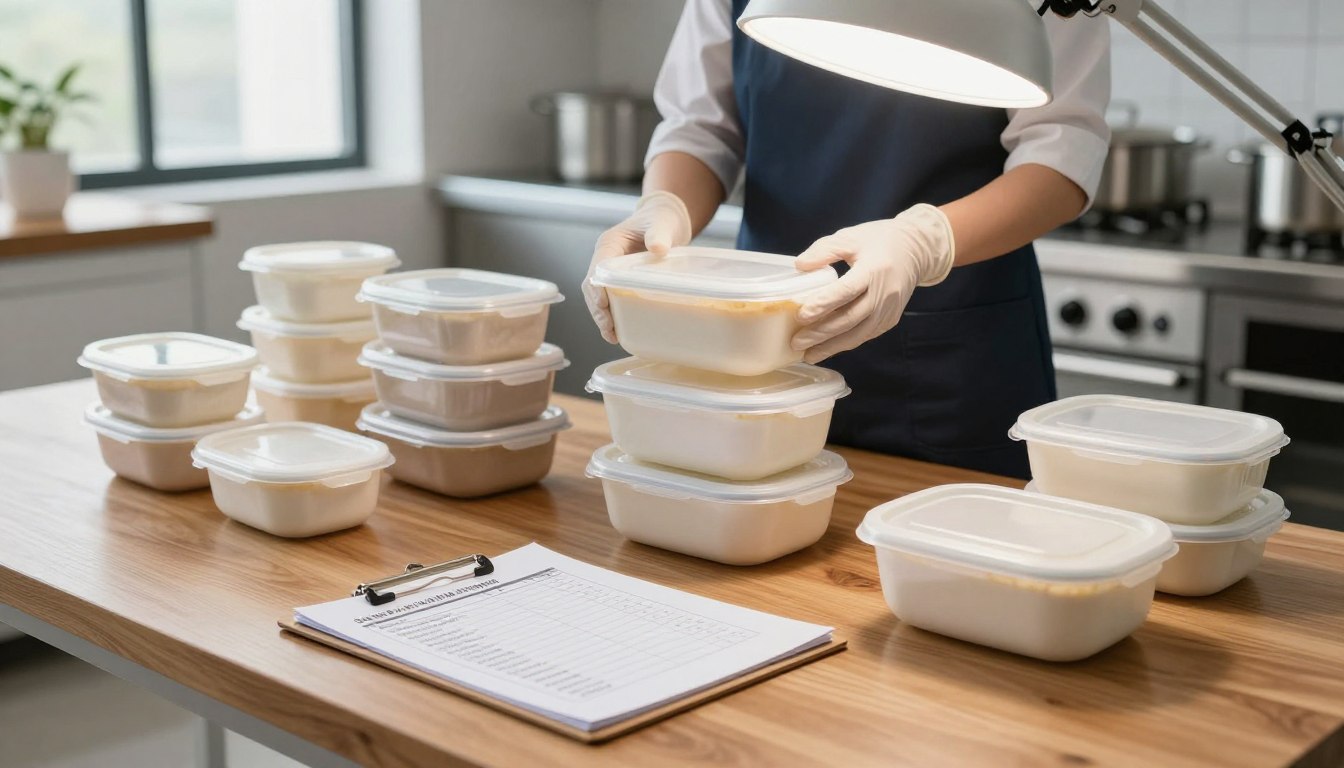
A clean, organized workspace featuring a variety of disposable food containers with lids, meticulously arranged on a polished wooden table. In the foreground, a clipboard with a checklist of safety and hygiene quality standards, neatly detailed and clearly visible. In the middle, a person in professional business attire, wearing gloves, inspecting a food container under a bright overhead light, emphasizing meticulous quality control processes. The background shows a modern kitchen with stainless steel appliances and a large window letting in natural sunlight, creating a safe, welcoming environment. The mood is one of professionalism and assurance, reflecting commitment to hygiene standards in food safety.
Microbiological Safety Testing
Testing for microbiological safety is key. It checks for potential microbial contamination in containers.
Sterility Requirements
Containers need to be sterile to stop harmful microorganisms from growing. They must be made and packaged to avoid contaminants.
Bacterial and Fungal Contamination Limits
Setting limits for bacterial and fungal contamination is crucial. These limits ensure containers are safe for consumers. For example, they should not have harmful pathogens like Salmonella or E. coli.
Migration Testing
Migration testing is also important. It checks if chemicals from the container can get into food.
Food Simulant Testing Protocols
Protocols for food simulant testing mimic how food interacts with containers. This helps understand the effects of different foods on container materials.
Migration Limits for Different Food Types
Migration limits vary by food type. This is because different foods can affect how chemicals move from containers. Setting these limits is key to safety.
Manufacturing Environment Standards
The environment where containers are made is crucial for their safety and hygiene.
Clean Room Requirements
Manufacturing in clean rooms or controlled environments reduces contamination risk. Clean rooms have low levels of particles and microorganisms.
Quality Management System Certifications
Having a quality management system (QMS) certified to international standards is important. This ensures manufacturers follow strict quality and safety rules.
By following these standards, manufacturers can make sure their containers are safe. They also meet regulatory requirements.
Packaging, Labeling, and Documentation Requirements
The packaging, labeling, and documentation of disposable food containers with lids are key. They ensure these items meet quality and regulatory standards.
Packaging Protection Standards
Packaging protection is crucial. It makes sure disposable food containers arrive safely. Several important factors are involved.
Carton Strength and Pallet Configuration
Cartons need to be strong to handle shipping. The right pallet setup is also vital to avoid damage.
Moisture and Contamination Protection
Food containers must stay dry and clean during shipping. Using the right packaging materials helps achieve this.
Labeling and Traceability
Good labeling and traceability are essential. They help follow regulations and keep customers happy.
Product Identification Requirements
Labels should clearly show what's inside. They must also include safety information.
Batch and Lot Number Tracking
Batch and lot numbers on labels help track products. This is important for recalls if needed.
Documentation and Test Reports
Having detailed documentation and test reports is crucial. They prove that products meet quality and safety standards.
Document Type | Description | Frequency |
Material Certifications | Certifies that materials used meet food-grade standards | Per shipment |
Test Reports | Details the results of quality and safety testing | Per batch or lot |
Packaging Compliance Docs | Verifies packaging meets regulatory requirements | Annual or as required |
By focusing on packaging, labeling, and documentation, we meet standards. This ensures our disposable food containers with lids are up to par.
Conclusion
When looking for disposable food containers with lids, businesses need to check quality control points. This ensures the products are safe and meet customer needs. Our study shows it's key to include important quality control factors in a Request for Quote (RFQ).
To create a good RFQ, consider material types, how well the containers hold up, and how well the lids fit. Also, think about size, safety, and how they're packaged. This way, businesses can find the right suppliers and get the products they need.
Good quality control is vital for keeping customers happy and loyal. By focusing on quality when buying disposable food containers with lids, businesses can avoid problems. This leads to better customer satisfaction and helps the business grow over time.
FAQ
Why is it essential for us to prioritize quality control when sourcing disposable food containers?
Quality control is key for food safety and customer trust. We check every container for safety and function. This keeps our customers happy and our brand image strong.
What specific material safety standards should we include in our RFQ?
We need FDA-approved materials that are BPA-free and phthalate-free. It's also important to check for heavy metals and additives. For green options, look for ASTM D6400 or BPI certification.
How do we verify that the containers are durable enough for delivery services?
We ask for drop test results and compression resistance in our RFQ. This makes sure containers stay safe in delivery bags. It protects the meal and the customer's experience.
Can these containers handle both extreme heat and cold storage?
We set temperature resistance levels for each use. This includes microwave and freezer safety. Materials like Polypropylene (PP) handle heat well, while PET is good for cold displays.
How do we ensure the lids provide a secure, leak-proof seal?
We test the lid attachment and seal integrity. This ensures soups and sauces stay in. Tamper-evident features also keep food safe from the kitchen to the customer.
What are the requirements for container stackability and storage?
We check nesting ratios and stacking limits for warehouse efficiency. This ensures containers fit well and inventory is easy to manage.
How do we monitor hygiene and contamination risks during manufacturing?
We require clean room standards and ISO 9001 or BRCGS certifications. We also test for bacteria and fungi. This keeps the plastic safe for food.
What documentation do we need to ensure full traceability?
We need detailed documentation and test reports for each shipment. This includes batch and lot numbers. It helps us quickly solve quality issues and keep our supply chain clear.
Contact
Leave your information and we will contact you.
电话
Whatapp